
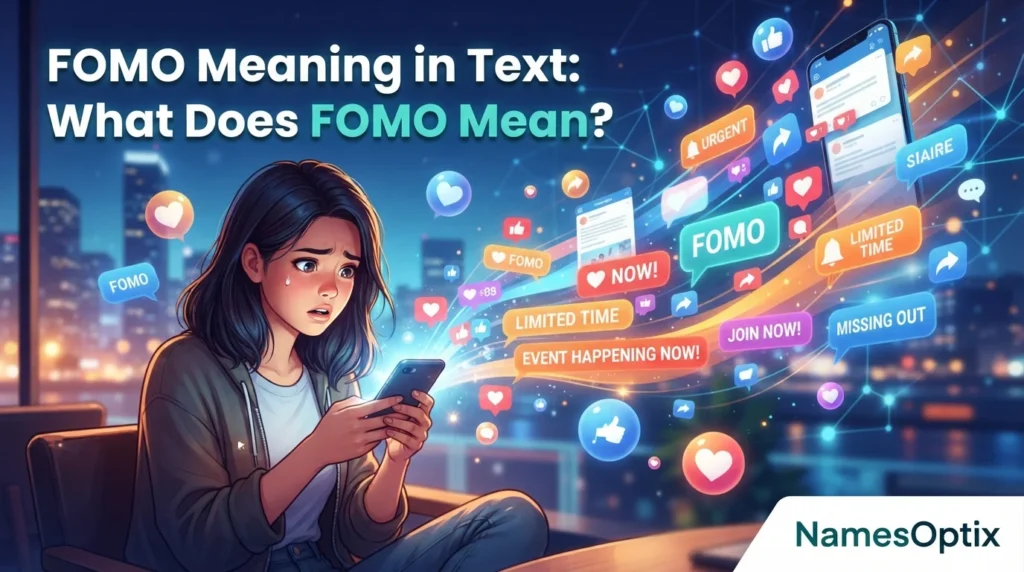
If you see FOMO in a text, chat, TikTok comment, Snapchat message, or Instagram post, it usually means “Fear Of Missing Out.” It describes the feeling that you might be missing something fun, exciting, important, or valuable while other people are experiencing it.
For example, if your friends go to a party without you and you see their pictures afterward, you might text, “I have major FOMO right now.” In that context, you are saying that you wish you had been there.
What Does FOMO Mean in Text?
FOMO means “Fear Of Missing Out.”
In texting, FOMO is used when someone feels left out or worries that they are missing an enjoyable experience, event, opportunity, trend, or activity.
Simple meaning:
FOMO = Feeling like you are missing something that other people are enjoying.
For example:
- “Everyone went to the concert. I have FOMO.”
- “I should’ve gone with you guys. Major FOMO!”
- “This party looks amazing, giving me FOMO.”
- “I don’t want to miss the sale because of FOMO.”
The term is generally casual and can be serious, humorous, or playful depending on the conversation. Dictionaries define FOMO as an informal abbreviation for “fear of missing out,” particularly the worry that others are experiencing exciting events without you.
What Does FOMO Stand For?
FOMO stands for:
F = Fear
O = Of
M = Missing
O = Out
So, FOMO = Fear Of Missing Out.
It is an acronym that has become common in everyday English, texting, social media, marketing, and discussions about online behavior.
How Is FOMO Used in Text Messages?
People usually use FOMO to express that they wish they were participating in something.
When You Miss an Event
Friend: “We’re all going to the beach tomorrow.”
You: “Ugh, FOMO. I wish I could come.”
Here, FOMO means you feel disappointed about missing the experience.
When You See Friends Having Fun
“Just saw your party pictures. I’m getting serious FOMO 😂”
This can be completely playful. The person is saying they wish they had been there.
When You Regret Staying Home
“I decided not to go, but now I have FOMO.”
This means the person is regretting their decision after realizing they may have missed something enjoyable.
When Something Is Trending
“Everyone is playing this game now. FOMO made me download it.”
Here, FOMO describes the feeling of wanting to participate because other people are doing it.
FOMO Meaning on TikTok
On TikTok, FOMO generally has the same meaning: Fear Of Missing Out.
People may use it in captions, comments, videos, or conversations when they see something they wish they could experience.
Examples include:
- “Everyone is at the concert and I’m stuck at home. FOMO 😭”
- “This video is giving me FOMO.”
- “The whole friend group went without me. Major FOMO.”
- “FOMO made me buy the tickets.”
TikTok can intensify the feeling because users constantly see videos of other people’s trips, parties, events, purchases, trends, and experiences.
FOMO Meaning on Snapchat
On Snapchat, FOMO also means Fear Of Missing Out.
It commonly appears when someone sees friends’ Stories showing an activity they were not part of.
For example:
“Why didn’t you tell me you guys were going out? FOMO 😭”
The person means they wish they had been included.
Someone might also post a Snapchat Story saying:
“Posting this just to give you FOMO 😂”
In this case, the phrase is usually playful. They are teasing friends by showing them something fun they are missing.
FOMO Meaning on Instagram
On Instagram, FOMO can describe the feeling caused by seeing posts, Reels, Stories, or photos of other people doing exciting things.
For example:
“Your vacation photos are giving me FOMO.”
This means the person’s vacation looks so enjoyable that you wish you were experiencing it too.
FOMO can also appear in captions such as:
“Don’t let FOMO stop you from joining us.”
The meaning remains the same, even though the context changes.
Is FOMO Positive or Negative?
FOMO can be either negative or playful, depending on how it is used.
The traditional meaning involves an uncomfortable feeling of missing something. It can involve worry, regret, social pressure, or feeling left out.
However, in everyday texting, people often use FOMO casually.
For example:
“That pizza looks amazing. FOMO!”
This does not necessarily indicate serious anxiety. It can simply mean:
“I wish I were there!”
So you should consider the surrounding conversation before interpreting the emotional intensity.
FOMO Examples in Everyday Conversations
Here are some natural examples of how people use FOMO:
| Situation | Example |
| Party | “Everyone is at the party. I’m getting FOMO.” |
| Concert | “I skipped the concert and now I have FOMO.” |
| Vacation | “Your beach pictures are giving me FOMO.” |
| Friends | “You guys went without me? FOMO 😭” |
| Shopping | “That limited drop is giving everyone FOMO.” |
| Gaming | “Everyone is playing the new game, so I have FOMO.” |
| Food | “That burger looks so good. Major FOMO!” |
| Trend | “I finally joined the trend because of FOMO.” |
What Does “I Have FOMO” Mean?
When someone says “I have FOMO,” they usually mean:
“I feel like I’m missing out on something that other people are enjoying.”
For example:
“I didn’t go to the festival, and now I have FOMO.”
The person probably wishes they had attended.
Another example:
“I was going to stay home, but my FOMO got the better of me.”
This means the person decided to participate because they did not want to miss the experience.
What Does “Giving Me FOMO” Mean?
“Giving me FOMO” means that something is making you feel like you are missing out.
For example:
“Your vacation pictures are giving me FOMO.”
It means:
“Your pictures make me wish I were there too.”
This expression is particularly common in casual social media conversations.
What Does “Major FOMO” Mean?
“Major FOMO” means a strong feeling of missing out.
For example:
“Everyone is at the festival. Major FOMO!”
The person is emphasizing that they really wish they could participate.
Similar expressions include:
- “Serious FOMO”
- “Huge FOMO”
- “Big FOMO”
- “Getting FOMO”
- “Feeling FOMO”
- “FOMO is real”
Is FOMO Rude or Offensive?
No, FOMO is generally not rude or offensive.
It is a common informal expression used to describe a feeling. Friends may use it jokingly, especially when someone posts pictures from an event or activity.
For example:
“Posting this just to give you FOMO 😂”
This is normally playful rather than insulting.
However, context matters. If someone repeatedly uses FOMO to pressure another person into spending money, attending events, or making a decision, the expression can be connected to social pressure.
FOMO vs. JOMO
A useful related term is JOMO, which means “Joy Of Missing Out.”
The two terms express opposite attitudes.
| Term | Meaning |
| FOMO | Fear Of Missing Out |
| JOMO | Joy Of Missing Out |
FOMO is the feeling that you do not want to miss what others are doing.
JOMO is the feeling of being happy or comfortable with staying out of something.
For example:
“Everyone is going out tonight, but I’m staying home and enjoying some JOMO.”
Where Did FOMO Come From?
The idea behind “fear of missing out” existed before the acronym became popular. Dictionary.com traces the term to the early 2000s, while Merriam-Webster records its first known use as 2004.
Patrick McGinnis is widely associated with popularizing the acronym FOMO in a 2004 article published through Harvard Business School’s student publication, The Harbus. Academic research also notes earlier uses of the phrase “fear of missing out,” so the exact origin of the underlying expression is broader than the acronym itself.
Social media later helped make FOMO a widely recognized part of everyday vocabulary.
Why Is FOMO So Common on Social Media?
Social media makes it easy to see what other people are doing in real time.
You might see:
- Friends attending a party
- Someone traveling
- A concert you missed
- A new product everyone is buying
- A viral challenge
- A popular restaurant
- A major sporting event
- Friends hanging out without you
Seeing these experiences can create the impression that other people are constantly doing something exciting.
That is why FOMO is particularly associated with social media. Cambridge Dictionary specifically describes FOMO as a worried feeling about missing exciting events, especially when triggered by things seen on social media.
How to Respond When Someone Says “FOMO”
Your response depends on the situation.
Friendly Response
“You should’ve come!”
Reassuring Response
“Don’t worry, we’ll do it again soon.”
Playful Response
“Haha, that’s what you get for staying home 😂”
Invitation Response
“Next time you’re definitely coming with us.”
If You Are Sharing Something Fun
“Sorry, but I had to post it 😂”
There is no special response required. FOMO is usually casual internet language.
Common FOMO Phrases
You may see FOMO used in several forms:
- I have FOMO
- I’m getting FOMO
- Major FOMO
- Serious FOMO
- FOMO is real
- This is giving me FOMO
- Don’t give me FOMO
- FOMO made me go
- FOMO made me buy it
- Posting this to give you FOMO
All of these generally relate to the same basic idea: not wanting to miss out.
FOMO in Different Contexts
FOMO is not limited to parties or social events. The same idea can apply to many situations.
Shopping
A limited-time sale or product release can create FOMO.
“The shoes are almost sold out. FOMO made me order them.”
Gaming
Players may feel FOMO when friends are playing a new game or participating in a limited event.
“Everyone is online tonight. I don’t want FOMO.”
Work
Someone might feel FOMO about an opportunity, conference, project, or career decision.
“Everyone from the industry is attending the conference, and I’m getting FOMO.”
Investing
FOMO can describe buying an asset because other people appear to be making money from it.
“He bought it because of investment FOMO.”
In this context, the term has moved beyond social activities and describes the fear of missing a potentially valuable opportunity.
FOMO vs. Simply Wanting to Join
FOMO does not always mean that someone genuinely wants to participate.
Sometimes a person simply wants to know what they are missing.
For example:
“I’m not really into clubs, but I still have FOMO seeing everyone else’s stories.”
The person may not actually want to attend. They simply dislike the feeling that something is happening without them.
That distinction is important because FOMO is about the feeling of missing out, not necessarily the actual desire to participate.
Frequently Asked Questions
What does FOMO mean in texting?
FOMO means “Fear Of Missing Out.” In texting, it describes the feeling that you are missing something fun, exciting, important, or valuable that other people are experiencing.
What does FOMO stand for?
FOMO stands for Fear Of Missing Out. It is an informal acronym commonly used in texts, social media, online conversations, and everyday speech.
What does “I have FOMO” mean?
“I have FOMO” means “I feel like I’m missing out.” Someone might say this after seeing friends at a party, traveling, attending an event, or enjoying something they could not experience.
What does “giving me FOMO” mean?
“Giving me FOMO” means that something is making you feel like you are missing out. For example, “Your vacation pictures are giving me FOMO” means the pictures make you wish you were there.
What does FOMO mean on TikTok?
On TikTok, FOMO still means Fear Of Missing Out. People commonly use it when videos make them wish they were attending an event, trying a trend, visiting a place, or experiencing something shown in the video.
What does FOMO mean on Snapchat?
On Snapchat, FOMO means Fear Of Missing Out. It is often used when someone sees friends’ Stories and wishes they had been included in the activity.
Is FOMO a bad thing?
Not necessarily. FOMO can describe a genuine uncomfortable feeling, but people also use the term casually or jokingly. The meaning and emotional intensity depend on the context.
What is the opposite of FOMO?
The commonly used opposite is JOMO, meaning “Joy Of Missing Out.” It describes being happy or comfortable with choosing not to participate.
Is FOMO slang?
FOMO is an informal acronym that is widely used as everyday internet and texting language. Major dictionaries now recognize it as an established informal term.
How do you pronounce FOMO?
FOMO is commonly pronounced “FOH-moh”, with two syllables. Cambridge Dictionary lists the American pronunciation as /ˈfoʊ.moʊ/.
Final Answer
If someone uses FOMO in a text, they almost always mean “Fear Of Missing Out.” It describes the feeling of being left out or worrying that you are missing an exciting experience, opportunity, trend, or activity. In modern texting and social media, it can be serious, but it is very often used casually or jokingly. Whether you see it on TikTok, Snapchat, Instagram, WhatsApp, or in a group chat, the basic meaning remains the same: “I don’t want to miss out.”

Emma Carter is an experienced Editor-in-Chief with more than 15 years of experience leading digital publishing teams and developing high quality editorial content across multiple industries. She specializes in editorial strategy, content governance, SEO publishing, and audience engagement. Throughout her career, Emma has worked with writers, editors, researchers, and digital marketing professionals to produce trustworthy, well researched, and reader focused content.